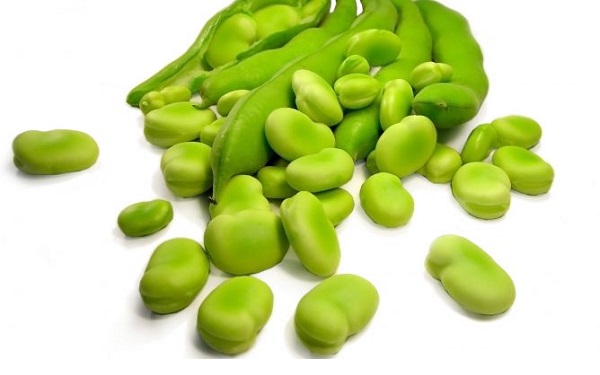
HABA
Descripción: El haba tiene porte recto y erguido, con tallos fuertes y angulosos de hasta 1,6 m de altura. Sus hojas aparecen sobre el tallo en disposición alterna, son compuestas paripinnadas.
Las flores se presentan agrupadas, de cinco a ocho, en el extremo de una corta espiga, que nace a su vez de la axila de las hojas superiores. Son grandes, comparadas con las de otras especies del género, alcanzan 4 cm.
El fruto es una legumbre, en forma de vaina, con dos valvas unidas por sendas suturas, de sección casi cilíndrica o ligeramente aplastada, con las suturas muy poco resaltadas, indehiscente. Su tamaño no difiere mucho entre variedades, la longitud oscila entre 10 y 30 cm y la anchura entre 2 a 3 cm
La raíz del haba crece en profundidad hasta alcanzar un largo similar al del tallo de la planta. Como otras fabáceas, los nódulos de la misma tienen la propiedad de fijar nitrógeno en el suelo.
Plagas y enfermedades: Las plagas más corrientes de las habas son:
- El pulgón negro (Aphis fabae). Ataca los extremos herbáceos de los tallos. Para evitarlos puede ser muy útil el despunte de los tallos.
-
La sitona (Sitona lineatus), es un escarabajo curculiónido o gorgojo, que roe los bordes de las hojas dejándolas como festoneadas. Las larvas viven en el suelo.
-
El lixus (Lixus algirus), es otro escarabajo curculiónido cuya larva taladra el tallo secando la planta. Tiene poca importancia.
- El trips del guisante (Kakotrhips robustus) da lugar a unas hojas plateadas y vainas deformadas.
Cultivo: El haba se desarrolla bien en casi todos los tipos de suelo pero prefiere los que tengan un buen drenaje, aunque soporta también los arcillosos. Los suelos muy ligeros, húmedos o secos no le van bien; prefiere un pH entre 6 y 7,5. Requiere bastante humedad y unos 700 mm anuales de lluvia. No es particularmente fotófila, y al ser tolerante a las heladas en su desarrollo temprano se adapta a las condiciones de las zonas de montaña.
Usos:
Culinario
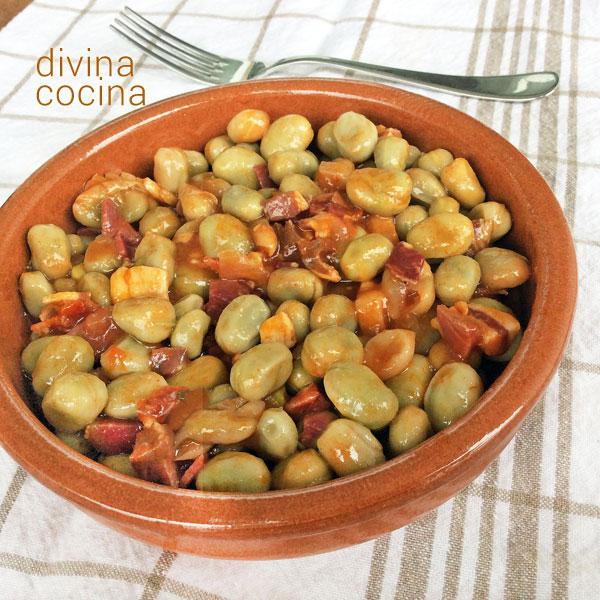
Habas frescas servidas como tapa.
Las semillas inmaduras se consumen como legumbre o secas como menestra. En algunas preparaciones suelen prepararse estofadas: un ejemplo son los michirones. Son ricas en carbohidratos y proteínas. A medida que maduran endurecen y ganan en almidón, por lo que se deben recolectar antes de su maduración. El filum de color oscuro o negro indica que ya no es recomendable para consumo humano.
Tradiciones
Las roscas y roscones de reyes, comidas en fechas señaladas (San Valero, Reyes Magos) coincidentes con las fiestas paganas de la siembra, la recolección, la primavera, etc., suelen llevar una o dos sorpresas. Una solía ser una moneda o regalo favorable, y la otra habitualmente desfavorable que obliga a pagar el roscón consiste generalmente en una semilla de haba.
BEAN
Description: The broad bean has a straight and upright bearing, with strong and angular stems up to 1.6 m high. Its leaves appear on the stem in an alternate arrangement, they are compound paripinnate.
The flowers are grouped, from five to eight, at the end of a short spike, which in turn is born from the axil of the upper leaves. They are large, compared to those of other species of the genus, reaching 4 cm.
The fruit is a legume, in the form of a pod, with two valves joined by two sutures, with an almost cylindrical or slightly flattened section, with very little raised sutures, indehiscent. Its size does not differ much between varieties, the length varies between 10 and 30 cm and the width between 2 and 3 cm.
The root of the broad bean grows deep until it reaches a length similar to that of the stem of the plant. Like other Fabaceae, its nodules have the property of fixing nitrogen in the soil.
Pests and diseases: The most common pests of broad beans are:
• The black aphid (Aphis fabae). It attacks the herbaceous ends of the stems. To avoid them, it can be very useful to trim the stems.
• The sitona (Sitona lineatus), is a curculionid beetle or weevil, which gnaws the edges of the leaves, leaving them scalloped. The larvae live in the soil.
• The lixus (Lixus algirus) is another curculionid beetle whose larva drills into the stem, drying the plant. It is of little importance.
• Pea thrips (Kakotrhips robustus) gives rise to silvery leaves and misshapen pods.
Cultivation: The broad bean develops well in almost all types of soil but prefers those with good drainage, although it also supports clay soils. Very light, moist or dry soils do not do well; prefers a Ph between 6 and 7.5. It requires a lot of humidity and about 700 mm of rain per year. It is not particularly photophilous, and being frost tolerant in its early development, it adapts to the conditions of mountain areas.
Applications:
Culinary
The immature seeds are eaten as a legume or dried as a stew. In some preparations stews are usually prepared: an example is the michirones. They are rich in carbohydrates and proteins. As they mature they harden and gain in starch, so they must be collected before they mature. The dark or black phylum indicates that it is no longer recommended for human consumption.
traditions
The threads and roscones de reyes, eaten on specific dates (San Valero, Reyes Magos) coinciding with the pagan festivals of planting, harvesting, spring, etc., usually carry one or two surprises. One used to be a favorable coin or gift, and the other usually unfavorable that requires paying the roscón generally consists of a bean seed.