Bilingual Robotics
The 2nd year ESO students of the San Felipe Neri institute wanted to participate in the bilingual project by developing the following activities during this academic year:
The second-year ESO students followed these steps to create this bilingual project about the structures of Martos:
-They learned all the material related to the structures in order to later apply it to daily life in their own town, Martos. To do this, they followed these phases:
Phase 1: Theoretical Foundations and Basic Concepts
-The process began in technology class where students thoroughly studied the concepts of structures. They learned that a structure is a set of elements capable of withstanding forces, protecting objects, or maintaining a shape, defining key concepts such as stability, strength, rigidity, and equilibrium.
Phase 2: Study of Structural Typologies
Next, they analyzed the different types of structures, understanding their purpose and the types of materials they contain. Examples of structures they studied included massive, vaulted, framed, triangulated, suspended, laminar, and geodesic structures.
Phase 3: Structural Elements and Stresses
Students studied the components that make up a structure, learning to identify foundations, columns, beams, load-bearing walls, and slabs in real buildings. They also analyzed the different types of stresses to which these elements are subjected: tension, compression, bending, torsion, and shear, understanding how each material reacts to them.
Phase 4: Knowledge Assessment
Having covered all the theory, the students took the unit exam. This test assessed their understanding of the typologies, their ability to recognize elements, and their basic stress calculations, ensuring that their theoretical knowledge was solidified.
Phase 5: Practical Application (Project)
With a solid theoretical foundation and having passed the assessment, the students began the practical phase: the project. This stage consisted of creating a 3D model of Martos using various apps. This concludes this learning stage.
- Next, they applied what they had learned to historical structures in Martos, such as the Keep and the Virgin of the Town. They researched in depth the history of their chosen structure in Martos, analyzing how it has evolved over time and its importance to the city and its inhabitants. They also studied the type of structure and the materials used in its construction, observing the characteristics and properties of each, such as resistance. Since this was a bilingual project, they wrote all this information in English in a separate document, taking into account everything said and done about this work. The students worked on a project focused on the structures in our surroundings, combining knowledge of engineering, digital design, and additive manufacturing. Specifically, we focused on analyzing and recreating architectural structures in our town, Martos, and then transferring them to the digital and physical worlds.
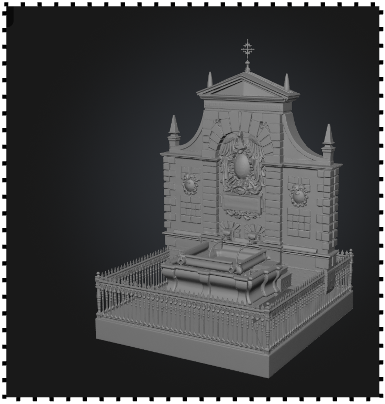
- As a first step, each student chose a structure of interest and took a photograph of it. These images were imported into Meshy.AI, an advanced artificial intelligence application that generates three-dimensional representations of objects from 2D images. Meshy.AI works by processing the original photograph and transforming it into a detailed 3D model, preserving the proportions, textures, and architectural features of the structure. The platform is very intuitive and allows users to adjust different parameters to improve the model’s accuracy, as well as visualize the structure from various angles before printing. Once the three-dimensional models were obtained, our teacher selected the most striking ones to publish in this document, and we will also use the most accurate and aesthetically pleasing versions for their physical creation. For this, we will use the center’s Creality 3D printer, under the supervision of our teachers. This process will allow us to understand in a practical way how a digital design can become a tangible object, directly observing how the layers of material are deposited and how virtual dimensions translate into the real world. Furthermore, it helped us reinforce concepts learned about geometry, structural strength, and model scaling. These three-dimensional reproductions of the Martos structures not only represent an advance in our technical and digital skills, but also help us to appreciate the importance of design and engineering in our everyday environment.
Some of the best projects, selected by Professor Alicia Navas Martínez…
3D model of Mario Izquierdo 2ºA

3D model of Adrián Ruíz 2ºB

3D model of Marta Burguillos 2ºB

3D model of Daniela Ramos 2ºA

3D model of Gisela Moreno 2ºB

3D model of Mario Torres 2ºC

3D model of Daniel Carrasco 2ºB

3D model of Marta Pulido2ºC:
Pilar Fuente Nueva 3D.mp4
3D model of Victoria Montiel 2ºB
- Finally, with the goal of creating an interdisciplinary experience, the students in the Computing and Robotics class have collaboratively written a Google Docs report detailing every step of our bilingual project.
In this document, we describe each phase of the process: from the initial planning—where we defined our objectives and assigned team roles—to the research of technical concepts in both languages. We explain our methodology, the technical challenges we encountered, and the solutions we implemented to ensure the robot functioned correctly. Furthermore, we outline how we prepared our bilingual presentation, making sure all classmates could understand the content and participate actively.
To conclude, we included a reflection on the skills we developed: teamwork, creativity, organization, and bilingual communication. In doing so, we demonstrated how technology can integrate diverse areas of learning in a practical and enriching way.
This section concludes our article on our journey in robotics during the 2025-2026 school year. It has been an academic year full of engaging and practical lessons for our daily lives, where we have gained essential foundations not only in technology, but also for the real world.”
THE END