
Manufacturing Automation in Martos
1.1 Start of Mass Production in Martos
The beginning of mass production in Martos (Jaén) is closely linked to the establishment of the multinational Valeo, whose arrival decisively boosted the development of the automotive industry in the town. For approximately 60 years, this process has shaped Martos’ industrial identity, consolidating it as one of the main hubs of the automotive components sector in Andalusia and Spain.
– Foundation and Initial Boost
The establishment of Valeo España S.A.U. in Martos in 1971 marked the beginning of the town’s modern industrial development, playing a key role in the growth of the automotive components sector.
– Economic Transformation
Mass production, particularly of vehicle lighting systems, transformed the traditionally agricultural economy, turning Martos into a regional and national benchmark in the technology and automotive sectors.
– Industrial and Technological Consolidation
This growth led to the creation and consolidation of a major industrial park. Decades later, the ecosystem was strengthened with the establishment of the Centro Tecnológico Andaltec, consolidating Martos as the Andalusian epicenter of technical plastics.


1.2 Automation of Manufacturing in Martos (Jaén)
1. Introduction
Martos (Jaén) has become one of the main industrial centers in Andalusia, especially in the automotive sector. The evolution of manufacturing in this town has been marked by the progressive incorporation of automation and digital technologies into production processes.
2. Evolution of Manufacturing and Production
2.1 Traditional Production
In its early stages, industrial production in Martos was characterized by manual or semi-manual processes. Human intervention was essential in most production phases, which resulted in slower manufacturing speed, a higher possibility of errors, and less standardization.
2.2 Transition to Automation
With the growth of the automotive sector and the arrival of large industrial companies, automated machinery, robotic assembly lines, and digital quality control systems began to be implemented. This transition increased productivity, reduced costs, and improved competitiveness in national and international markets.
2.3 Current Automated Production
Today, factories in Martos use advanced technologies such as industrial robotics, smart sensors, artificial vision systems, and production management software. These tools enable more efficient, flexible manufacturing that is adapted to global market demands.
3. Impact on the Local Economy
Automation has had a positive impact on the local economy. Although some manual tasks have been reduced, new professional profiles have emerged in areas such as engineering, industrial maintenance, programming, and technology management. Martos has become an industrial reference point within the province of Jaén.
4. Conclusion
The evolution of manufacturing in Martos reflects the transition from a traditional production model to a highly automated and innovative one. The incorporation of new technologies has improved quality, increased production capacity, and strengthened the town’s position as an industrial engine in Andalusia.


1.3 How do we affect the evolution of fabrication technology in Martos?
We affect the fabrication technology adapting, capaciting and innovating here in Martos. In fact, we are the leaders in Andalucía in industrial production terms.
The principal activities that we do are:
– Industry 4.0 adaptation
Our society has adapted to the new advanced technology. Especially in the automotive and plastic sector.
– Dual personal formation
Workers and students participate in the dual formations that allows us to have recently formed people for the necessities of high technology.
-Technological ecosystem impulse
We made Martos the home of new enterprises with high technologic value.
This is our biggest enterprise here in Martos, Valeo.
So here is where the biggest group of persons are making Martos evolving in the sector of industry.

1.4 Types of robotics currently used in the manufacture of headlights
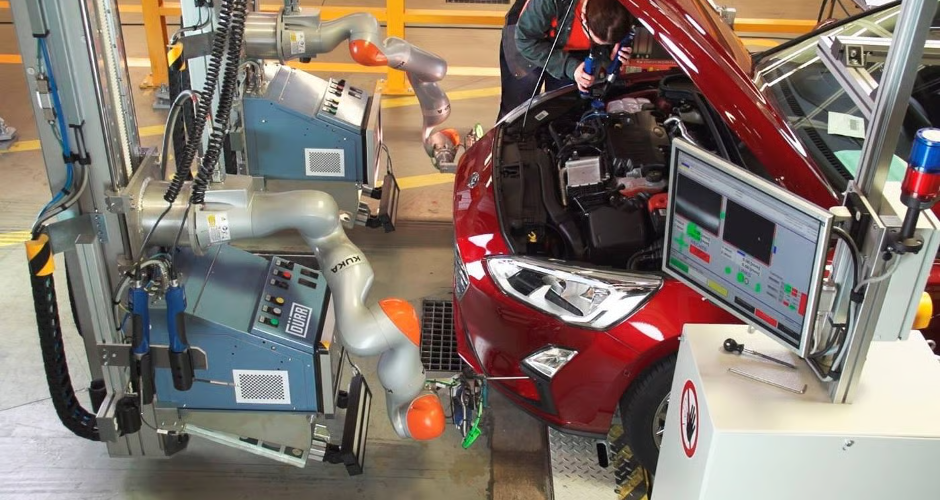
Valeo’s factory in Martos (Jaén) stands out for its use of advanced robotics in headlight manufacturing, with a high level of automation in assembly and internal logistics. It employs industrial robotic arms for precise positioning and automatic cable connection within the Plastrónica project, improving efficiency and accuracy. Furthermore, it incorporates machine vision systems for real-time quality control and autonomous mobile robots (AGV/AMR) that optimize internal material transport, reducing lead times and increasing production flexibility.
Main types of robotics at Valeo Martos:
– Assembly and Manipulation Robots (Industrial Arms):
Used for the precise assembly of components, automatic positioning of housings and cable connection.
– Plastronics Robots (Wiring Automation):
Advanced systems that automatically place and connect the wiring harness inside the headlight housing.
– Autonomous Mobile Robots (AMR/AGV):
Robots (similar to MiR) dedicated to intralogistics, transporting components and pallets within the plant to optimize production times.
– Artificial Vision and AI Systems:
Robots integrated with Artificial Intelligence for quality inspection of headlights, ensuring the correct functioning of the lighting functions.
– Sealing and Coating Robots:
Automatic application of adhesives and sealants to ensure the watertightness and proper sealing of the headlights.
These systems improve efficiency, reduce production times, and provide greater flexibility when adapting to changes in headlight design.
Página web: Valeo
1.5 Types of programming for the robot
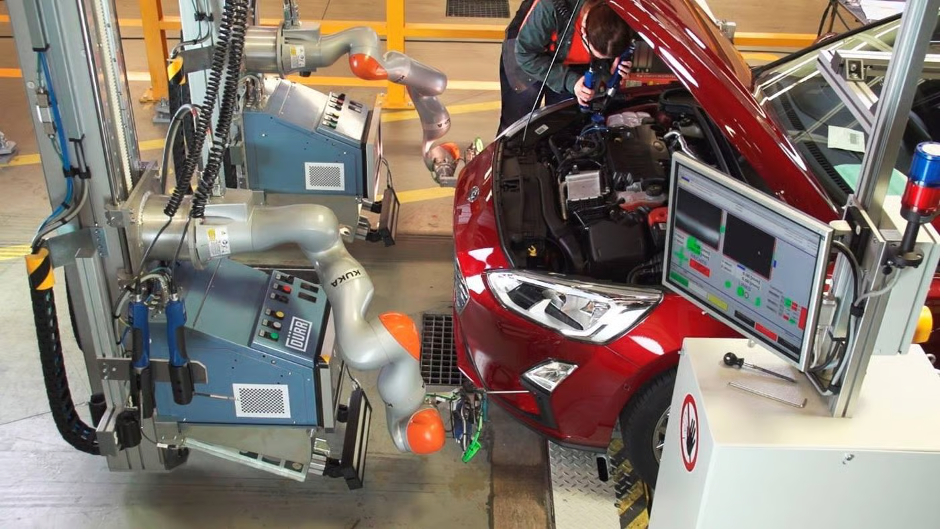
The programming languages used in industrial robots in Martos, as in the rest of industrial environments in Spain, depend mainly on the robot manufacturer. There is no universal language, but the most common ones are:
– RAPID for ABB robots, widely used in tasks such as welding, assembly, and material handling.

– KRL (KUKA Robot Language) for KUKA robots, ideal for repetitive applications like palletizing.

– Karel or Fanuc TP for FANUC robots, frequently used in packaging and production line automation.

In addition, general-purpose languages are also used, such as:
– C++: valued for its high performance and real-time control, especially in complex systems.

Videos:
Valeo Regloscope™ Pro – ¡Conduce con seguridad ajustando tus faros!
https://www.youtube.com/watch?v=UbRg7q743DQ
Valeo LED Exterior Lighting Technology Highlights
:Valeo LED Exterior Lighting Technology Highlights
Valeo Matrix Beam : maximum visibility without blinding other drivers | Valeo Service:
Valeo Matrix Beam : maximum visibility without blinding other drivers | Valeo Service